

Moralia in Job
by Gregory the Great, III:23-35
Manuscript in Latin on vellum
England, second half of the 12th century (probably before c. 1180)
400 × 285 mm
380'000.- (VAT not incl.)
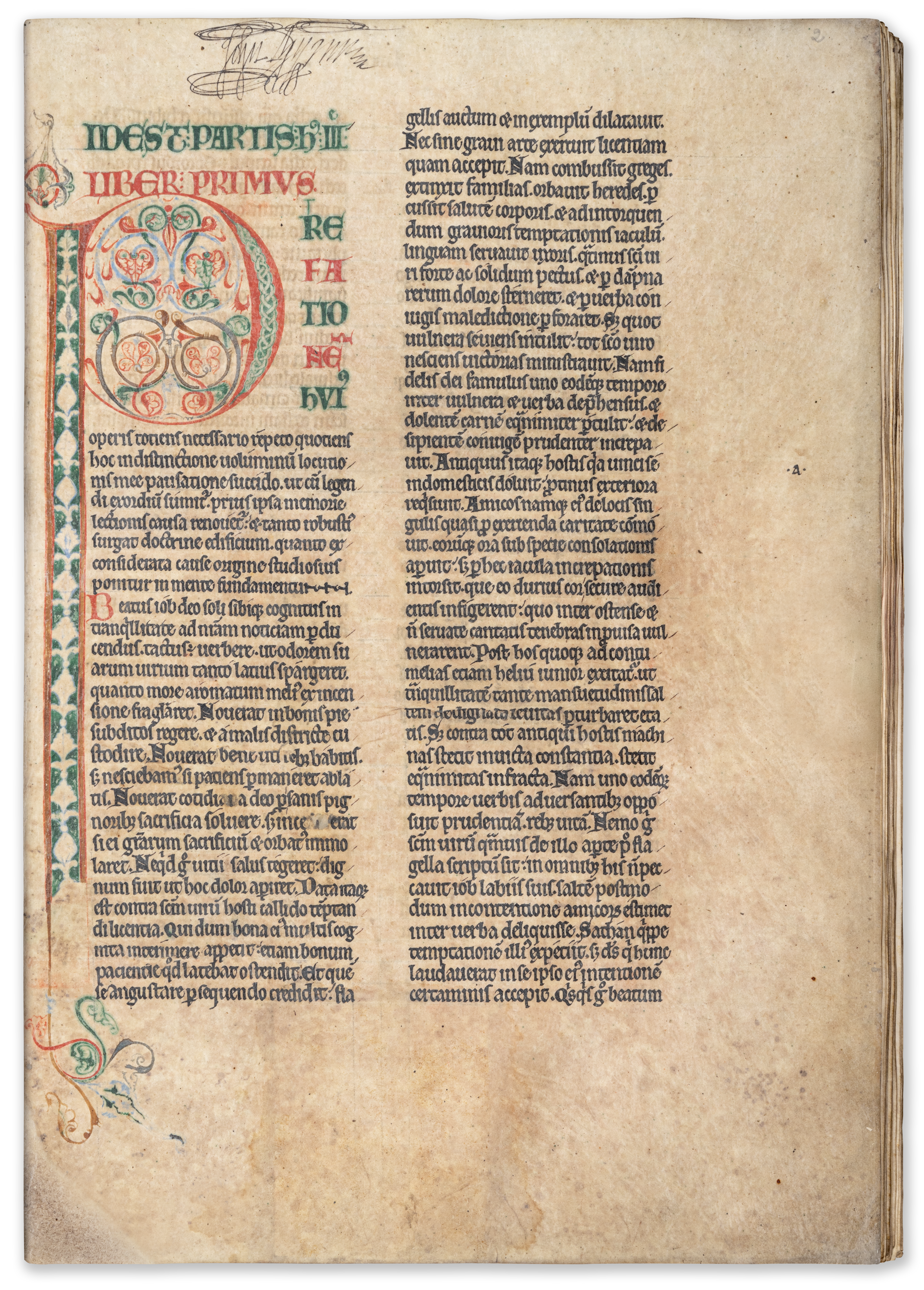
174 leaves. 13 finely executed 8-line multi-coloured arabesque initials in foliate and geometric designs in green, red, blue, and pale brown, the opening words of each book following a large initial written in majuscules on alternate lines. Complete. Bound in 19th-century English dark purple leather over pasteboards, the covers with blind-stamped panels, marbled endpapers, the spine lettered in gilt capitals ‘Gregorii / Magni / in Jobum / Moralia. // Sæc. XII.’, signed on the turn-in by Tuckett, binder to Queen Victoria, small scuffs to binding in places. Presentable condition.
This is a gargantuan English Romanesque copy of a fundamentally important Christian text, written in the magnificent de luxe format favoured for the finest books of the 12th century, with 13 exquisite arabesque initials; having survived the last four centuries in the grand library of the Marquesses of Bath at Longleat.
The Moralia in Iob by St. Pope Gregory the Great (c. 540-604) was written at the court of the Emperor Tiberius II in Constantinople between 578 and 595, and was one of the seminal texts of the medieval Church. It must have been found in almost every monastery, cathedral and ecclesiastical library in the West from the century or so before the Carolingian renaissance to the Reformation. It was a vast work, arranged by its author into six volumes, each with its own introduction, and by the High Middle Ages a division into three volumes was common, as with the present codex (the third volume of a set of three).
The kaleidoscopic initials and imposing Gothic script of this tome were designed to impress. The generous page size, far from economising on precious vellum, was a deliberate display of the patrons’ considerable wealth.