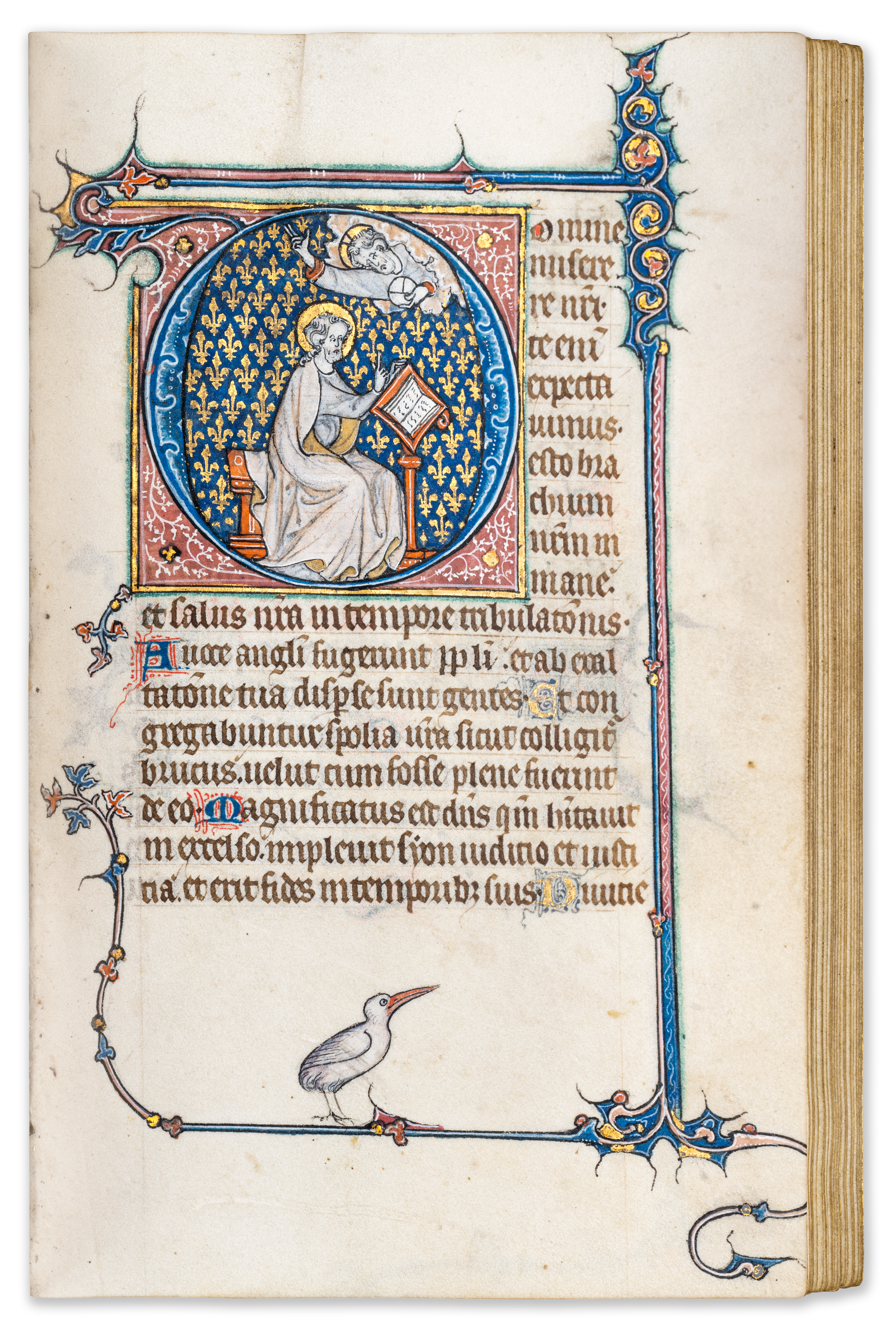


Psalter-Hours with calendar and canticles
- Master of Papeleu (Richard de Verdun?)
Manuscript in Latin on vellum
France, Paris, c. 1300-1320
120 x 80 mm
Price on request.
234 leaves. 10 historiated initials. Almost complete. 17th century red Morocco binding. Fresh, excellent condition.
This exceptional Psalter, illustrated by the renowned Master of Papeleu—possibly the son-in-law of the celebrated Maître Honoré — offers a rare glimpse into the elegance and sophistication of early 14th-century Parisian Gothic illumination.
The illustrated cycle in this manuscript, of delightful quality, was entrusted to an artist well-known and appreciated by the Parisian court in the 1300-1330s. This is the Master of Papeleu or the Master of the Bible of Jean de Papeleu, so named after a richly decorated Bible historiale, completed in 1317 (Paris, Bibliothèque de l’Arsenal, ms. 5059). This illuminator is primarily recognisable for his incisive and spirited art, characterised by an animated and fluid line. One of the first elements to catch the eye in his expressive and elegant compositions is his indebtedness to the renowned Maître Honoré, the most important artist in the Parisian scene at the very end of the 13th century. Their connection is such that some art historians have speculated that the Master of Papeleu might have been Maître Honoré’s son-in-law, Richard de Verdun, documented as an illuminator in late 13th-century tax records. These documents show Honoré and Richard de Verdun collaborating on numerous occasions, even residing for a time in the same house. We also know from those written sources that Richard de Verdun had an illustrious clientele: in 1318, the illuminator was paid for producing four volumes of antiphonaries for the Sainte-Chapelle in Paris.
One area where the Master of Papeleu can compete with his mentor is in his “chromatic sophistication”. Working with a limited palette of cool tones, the artist skilfully models figures, elegantly suggesting the volume of their bodies through the depiction of their garments. The greys, blues, and pinkish-oranges that dominate his palette are always applied in light washes, with white shadows, avoiding chromatic saturation. In contrast, the skin tones are left almost entirely white, with the characters’ faces occasionally highlighted with subtle touches of red or blue. While the treatment of the figures’ clothing is undoubtedly one of the aspects the artist handles with the greatest care, an unusual iconographic detail demonstrates the Master of Papeleu’s equal skill in depicting human anatomy. In the scene of the fool biting into an apple, which introduces Psalm 52, the illuminator presents the figure with his cloak fully open, revealing his naked body. The anatomical rendering is striking, showcasing a stylised and elegant figure in a dancing posture.
With vibrant, naturalistic birds surrounding each historiated initial, which is both sophisticated and ethereal, this previously unknown manuscript captures both the divine and the earthly in stunning detail.