


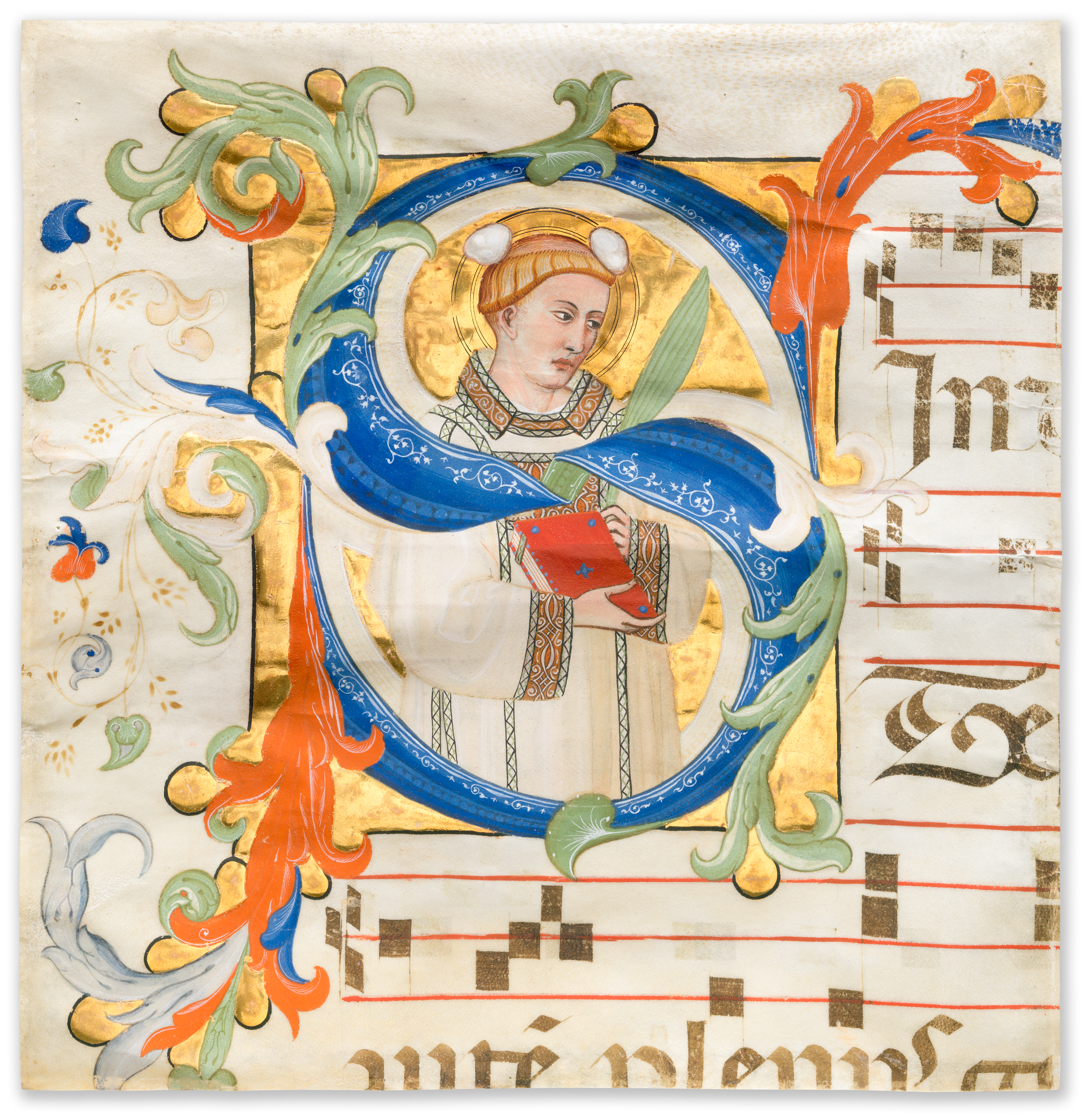
Saint Stephen
Initial S from an Antiphonary
- Don Simone Camaldolese
Tempera and gold on vellum
Italy, Florence, Santa Maria degli Angeli, c. 1390-1392
305 x 315 mm; initial: 20 x 17 mm
CHF 170'000,- (VAT not incl.)
Created for a monumental choir book, this exceptionally large miniature belongs to one of the most prestigious cycles of manuscript illumination produced in late medieval Florence.
Its origin in the choir books of Santa Maria degli Angeli immediately places it within an artistic enterprise of great ambition, involving some of the leading illuminators active in the city. The quality of the execution is equally remarkable, both in the monumental conception of the figure and in the refined treatment of the initial and its ornament. Its attribution to Don Simone is particularly significant, since his contribution to the Santa Maria degli Angeli series appears to have been limited to Corale 16. Don Simone’s very personal language gives the miniature and clear and limpid character, at once graceful and severe.
The choir books of Santa Maria degli Angeli formed one of the most important and ambitious programmes of manuscript production in Renaissance Florence and represent one of the crowning achievements of Florentine illumination. Produced over more than a century, from the later fourteenth to the early sixteenth century, they involved some of the finest illuminators active in the city. Work began around 1370 and continued in successive campaigns, notably in the 1390s and around 1406–10, with further phases of illumination around 1420 and 1450 and, finally, in 1505–06. Among the artists involved were Don Silvestro dei Gherarducci and Lorenzo Monaco, both closely associated with the monastery. So famous were the choir books that they were admired by Lorenzo the Magnificent and by his son Giovanni, the future Pope Leo X, that wanted to take the enemble to Rome. Today, eighteen of the choir books are preserved together in the Biblioteca Medicea Laurenziana in Florence.
A painter of Sienese origin, Don Simone became one of the leading exponents of neo-Giottesque culture in Florence during the last quarter of the fourteenth century. His art is characterised by a clear and measured narrative language and by a deeply human approach to the figure, still firmly rooted in the traditions of the Trecento.