





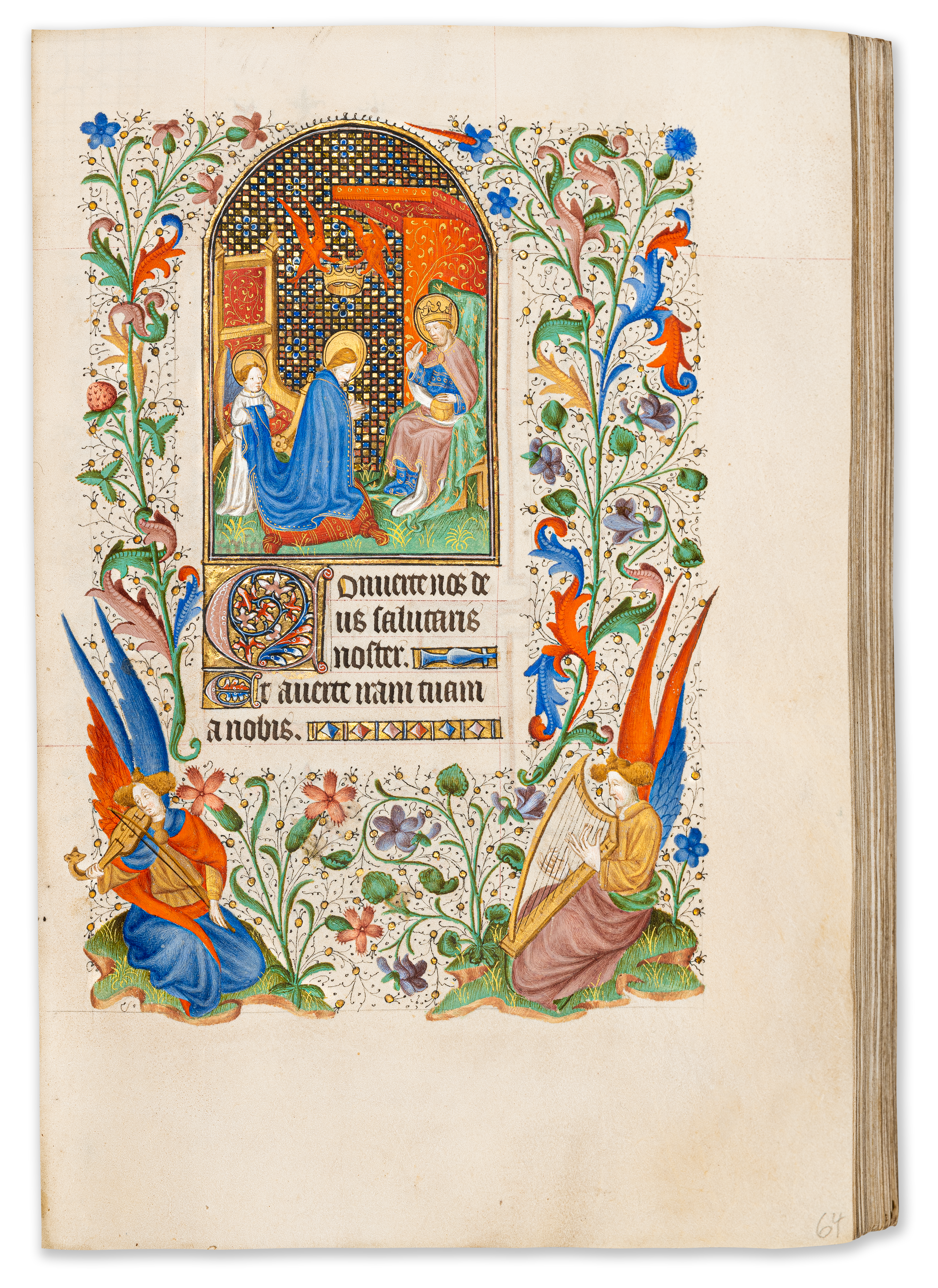
The Catherine Hours
- Workshop of the Harvard Hannibal Master
Manuscript in Latin with French prayers on vellum,
France, Paris, c. 1420-1425
267 x 187 mm
Price on request.
329 of (most likely 340) leaves. 25 large miniatures, remainder of calendar with 12 marginal rondels showing the zodiac and labours of the months. Red velvet binding, probably from the end of the 15th century, with seven of eight brass corners, brass clasps (not intact), nine out of ten brass buckles in form of wheels, probably referring to St. Catherine and thus to the presumed owner of the manuscript.
A spectacular manuscript with highly unusual, often erotic marginal decoration throughout, this fantastic personal devotional book was certainly made for a female patron, who was probably named Catherine.
A prestige production of this kind and its date suggest a royal provenance. This codex offers wonderful insights into the bawdy imagination of medieval artists and patrons, as well as a possible glimpse into the personal life of Queen Cathérine de Valois (1401-1437), who is our strongest contender for a possible first owner of this exquisite, endlessly entertaining, and surprisingly naughty treasure.
Three artists are responsible for the marvellous illuminations that can be stylistically connected to the Parisian artist dubbed the Master of the Harvard Hannibal. He is named after his miniature painting in a copy of Livy’s Décades. The fact that the Master of the Harvard Hannibal was frequently entrusted with creating frontispieces in deluxe manuscripts demonstrates the high esteem in which he was held by his contemporaries. He was an enormously talented illuminator, yet no monograph has been dedicated to this prolific artist.
This impressive manuscript was a collaborative project with a clear shared vision by all three artists; they deployed the same techniques of modelling and decoration. The modelling of the figures consists of delicate tiny lines of dots in grey, brown, and reddish hues layered over a grey-green foundation. Draperies are smooth and flowing and entirely dedicated to the soft style of the International Gothic. Hems are often accentuated with a thin golden line and a row of dots. Some of the angels’ tunics are painted in sumptuous liquid gold. Occasionally the backgrounds are finely diapered with burnished gold and colours. Scenery usually consists of the same elements, all of which come from the repertoire of the Harvard Hannibal Master: spiralling rocks, treetops fanned out like palm trees, and buildings with tipped pinnacles. The characteristic dark blue skies with golden rays, aureoles, or stars are very typical are for this style.
The lively, fanciful, and sometimes even explicit and erotic marginal decorations are an outstanding feature of this Book of Hours. They range from funny, loveable creatures with flowing scarfs, appalled looking owls, pensive catlike animals (f. 27v), to male figures showing their bare behinds or juggling while presenting their groins (f. 78r).


