

The Great Hours of Galeazzo Maria Sforza
Use of Rome
- Master of Ippolita Sforza
Manuscript in Latin and Italian on vellum
Italy, Milan, c. 1471-1476
350 x 240 mm
Price on request.
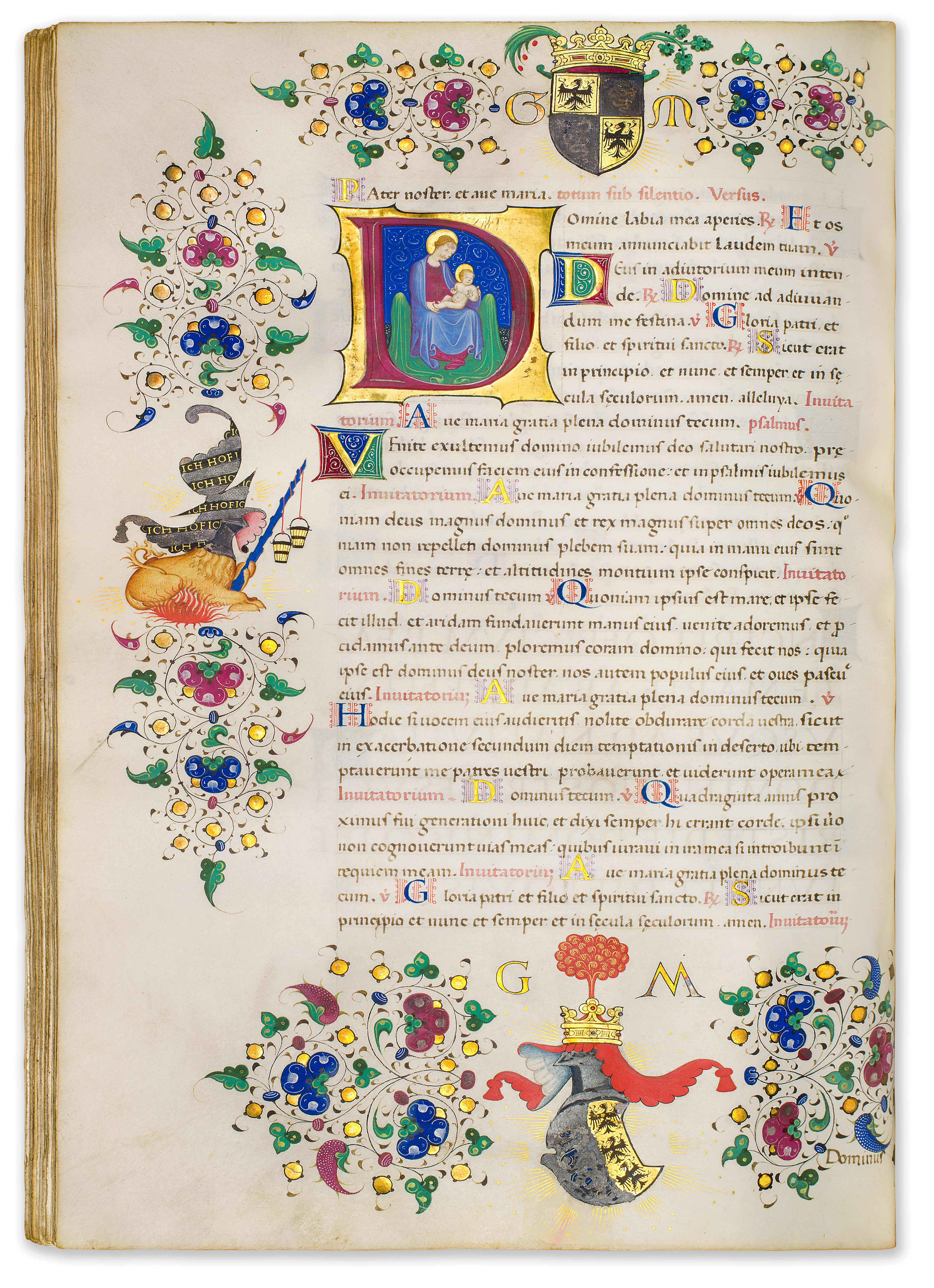
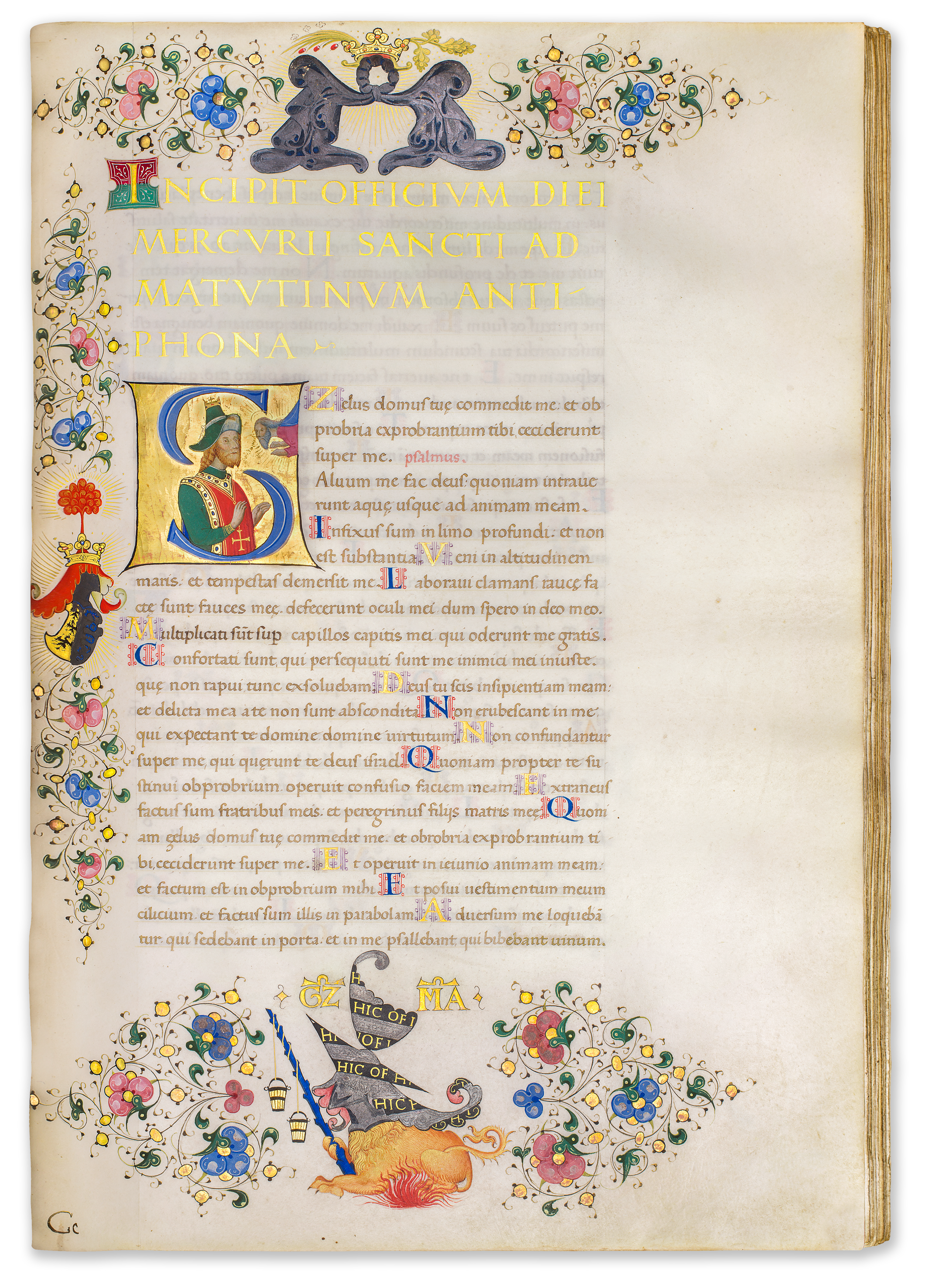
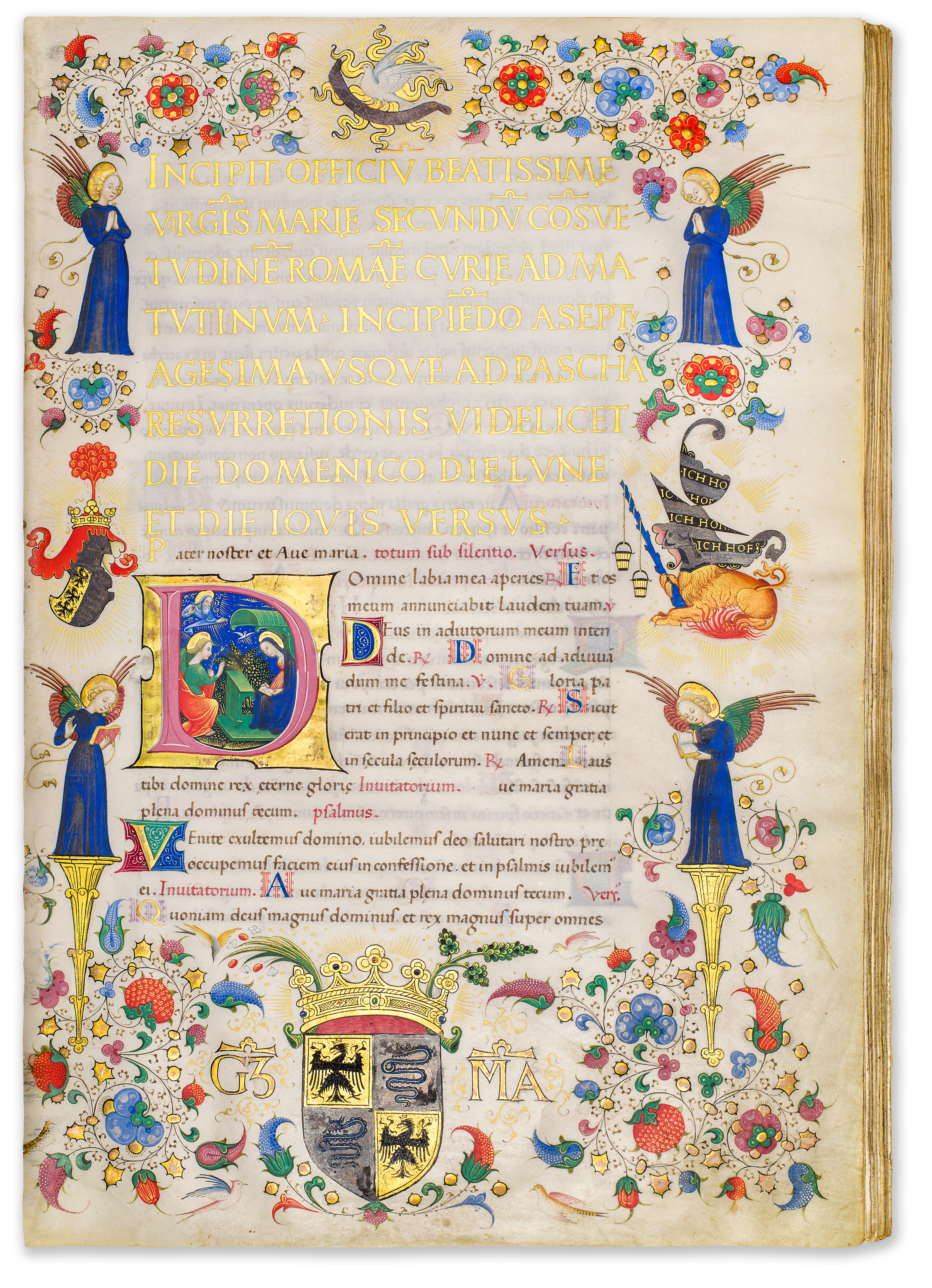
241 leaves. Almost 100 large illuminated initials, mostly five lines high painted in pink on grounds of gold with a flower-spray infill, three with crowned profile heads, small historiated initial with part-border, five splendid title-pages with golden display script, historiated initials and inhabited borders with emblems and heraldry. Complete. 18th-century Italian red morocco gilt binding.
Made for duke Galeazzo Maria Sforza (d. 1476), the large format, fine layout, balanced script and dazzling leaves with coats of arms and emblems, mark this truly princely manuscript.
The impressive codex dates after the election of Pope Sixtus in 1471 (f. 220r) and before the duke’s assassination on December 26, 1476. Five pages, illuminated by the Master of Ippolita Sforza, appeal with the refined depiction of the Sforza-Visconti quartered arms, the duke’s initials, monogram, mottoes and emblems (ff. 2r, 46r, 90r, 137v, 188r). Galeazzo Maria’s name is twice added in rubric (f. 237v, 240v) and likely his portrait too (f. 188r).
The date of completion can perhaps be narrowed down if the book was ordered for use in the ducal chapel in the Sforza castle in Milan, commissioned to be newly decorated in 1473 and to be finished within a year. For his art, Galeazzo’s decisions were determined by ‘his own taste and choice of subject matter’ (often including his and his family’s portraits). Presumably, it was the patron’s intention from the onset to prepare for prayers for the salvation of his soul: the image in the initial allegedly representing God speaking to David likely functions as a double portrait. Another example of God appearing to the duke was finished posthumously by Christophoro de Predis upon instruction of Bona of Savoy (1477, London, Wallace collection, M. 342).
Format, layout, script and illumination of arms and emblems make this manuscript into a truly princely and impressive codex. The illumination is attributed to the Master of Ippolita Sforza, named for this work for Galeazzo Maria’s sister Ippolita on the occasion of her marriage to Alfonso of Aragon in 1465 (Alexander 2016, p. 115,Toscano 2007, pp. 298-310; De Marinis 1947, pp. 173, 177, and 1952, p. 98).