

The St-Benet Holme Apocalypse
Expositio super septem visiones libri apocalypsi by Berengaurus
Decorated manuscript in Latin on vellum
England, Norfolk (?), late 11th or early 12th century
210 x 115 mm
This work has been sold.
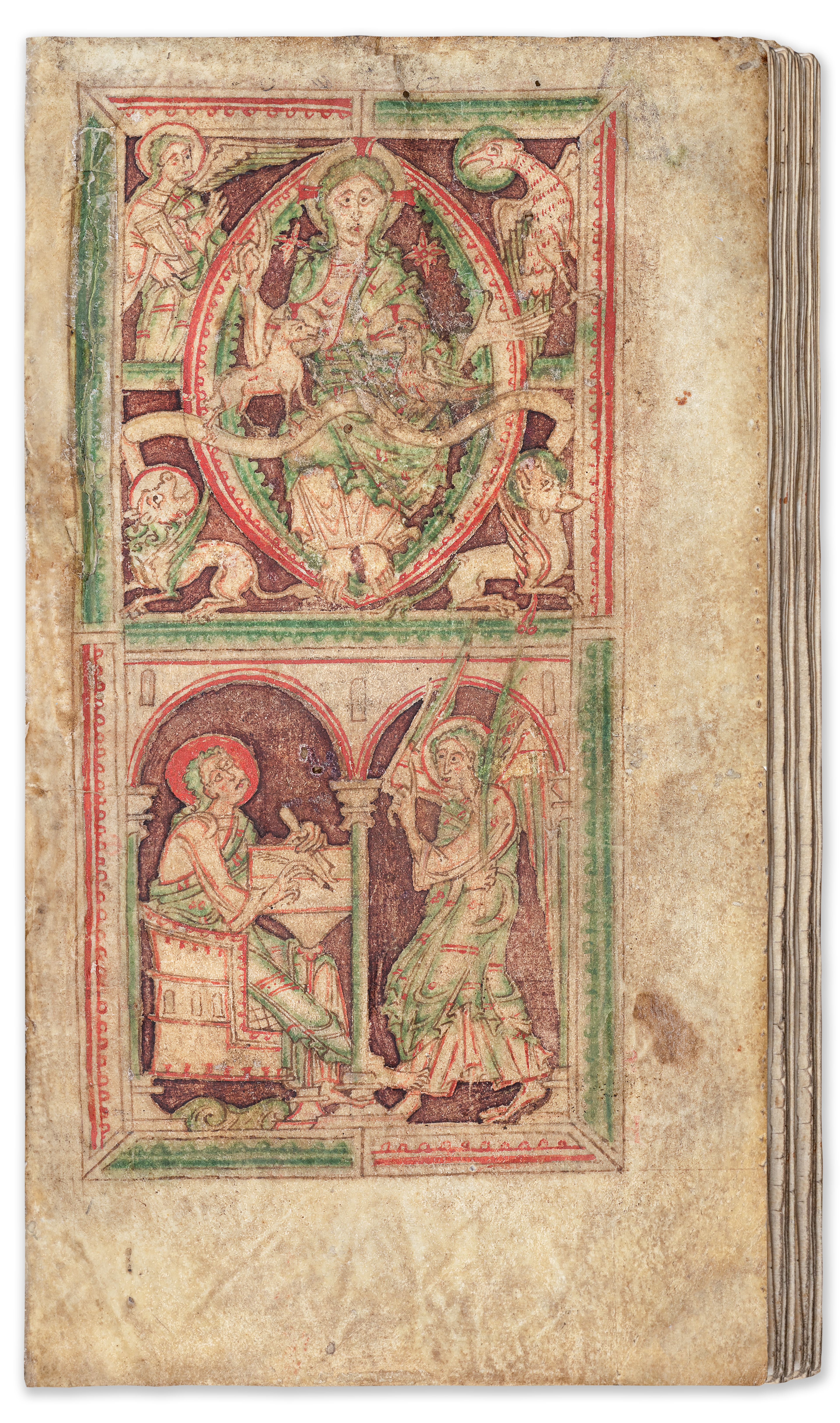
128 leaves. One full-page illustration and one historiated initial depicting a man battling a fantastic beast. Complete. 19th-century English black leather over pasteboards, sewn on five bands, with marbled endpapers, the covers and spine compartments framed by triple gilt fillets, the spine lettered in gilt capitals ‘Apocalipsis / cum / expositione / anonymi. / Sæc. XII.’, binding by Tuckett, binder to Queen Victoria. Good condition.
This tome is a rare example of the early Anglo-Norman book arts, made within living memory of the Norman Conquest, by a scribe and an artist who stood at the forefront of the cultural revolution that aimed to sweep away almost all vestiges of the Anglo-Saxon past to make way for Anglo-Norman England.
This manuscript appears to be the earliest recorded book to survive from the Abbey of Saint Benedict, St-Benet Holme. It is exceptional on many levels: The historical context of its creation, the importance and rarity of its text, as well as the striking artwork make it a remarkable source of English history.
The rarity of surviving manuscripts and records of St Benet Holme implies that the community met a destructive end. During the Norman Conquest, its abbot Ælfwold supported the English cause. The community was therefore later subjected to the imposition of Norman clerics loyal to the new regime into high offices. This process brought a blossoming of new learning and interest in Continental books, scripts and book-arts. Although St Benet Holme was abandoned during Protestant rule, it should be noted that it was the only English monastic house not forcibly closed during the Dissolution of the 1530s and 1540s – spared by Thomas Cromwell due to an extraordinary act of parliament.
The script corresponds with Northern French hands of the last decades of the 11th century. It is very likely that the scribe, while trained in Northern France, worked on this volume in England and could therefore be described as “Anglo-Norman”. Such a trajectory common during the times of the Norman Conquest.
The full-page miniature in this tome is composed as a striking two-level, bichromatic depiction of the Maiestas Domini and an angel dictating the text of the Apocalypse to Saint John the Evangelist. The artist used a characteristically Anglo-Saxon method of painting, possibly representing a “missing link” between the pictorial cycles of Carolingian Apocalypses and 13th century English ones.
The author of this early Apocalypse commentary is the Carolingian scholar Berengaurus from the monastery of Saint-Germain in Auxerre. Written in the context of the early Carolingian renaissance after the 880s, this text later became the most popular Apocalypse commentary in medieval England over the course of the 12th century, with excerpts of it surviving in most of the later English illustrated Apocalypses.
This manuscript was acquired by Sir Thomas Thynne in the 16th century and belonged to the glorious library of Longleat House, seat of the Marquesses of Bath (their MS. 2).