





Tiny Treasures
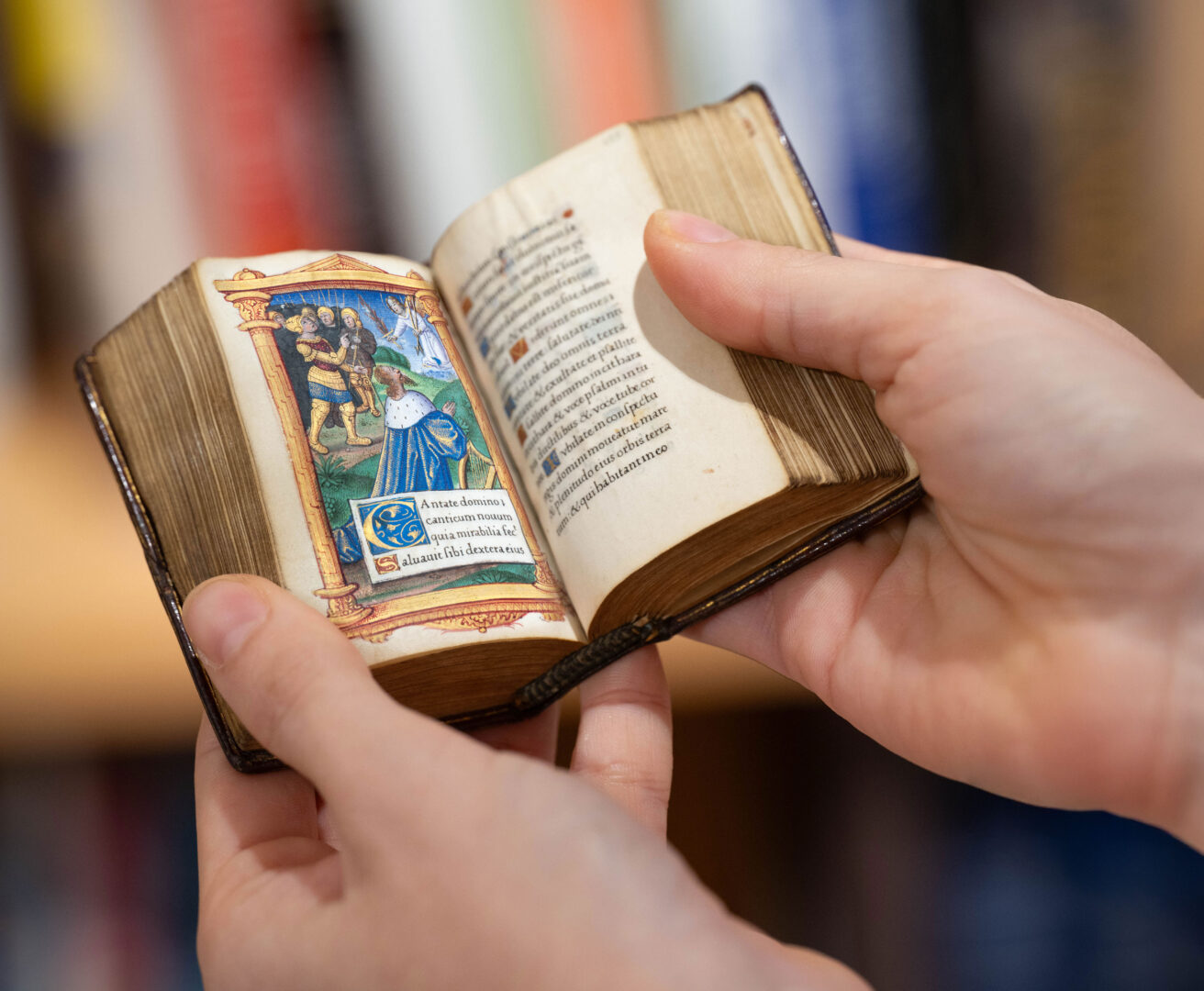
The Fascination of Minuscule Manuscripts at the French Royal Court
People have always been captivated by the extraordinary. Around 1500, the French royal court developed a remarkable taste for exquisitely crafted devotional manuscripts scarcely larger than a modern credit card.
Human beings have always been fascinated by extremes. We admire the tallest buildings, the largest diamonds and the tiniest of all portraits, carved into a cherry stone. Medieval patrons were no different. Already in the 14th century but even more so in the late 15th century, the French royal court developed a remarkable passion for devotional books so small that they could almost disappear in the palm of a hand. These exquisite manuscripts were certainly not merely practical objects for private prayer but astounding demonstrations of artistic virtuosity, pushing scribes, illuminators and binders to the very limits of their craft.
Book historians and collectors generally regard books measuring no more than three inches (76 mm) in either height or width as miniature* books. Although this definition primarily applies to printed books, several medieval manuscripts comfortably fall within these dimensions. Unlike later miniature books, however, these precious volumes were written entirely by hand, lavishly illuminated, and often bound in luxurious materials that gave them the appearance of pieces of jewellery. One famous example would be the alleged girdle book of Anne Boleyn.
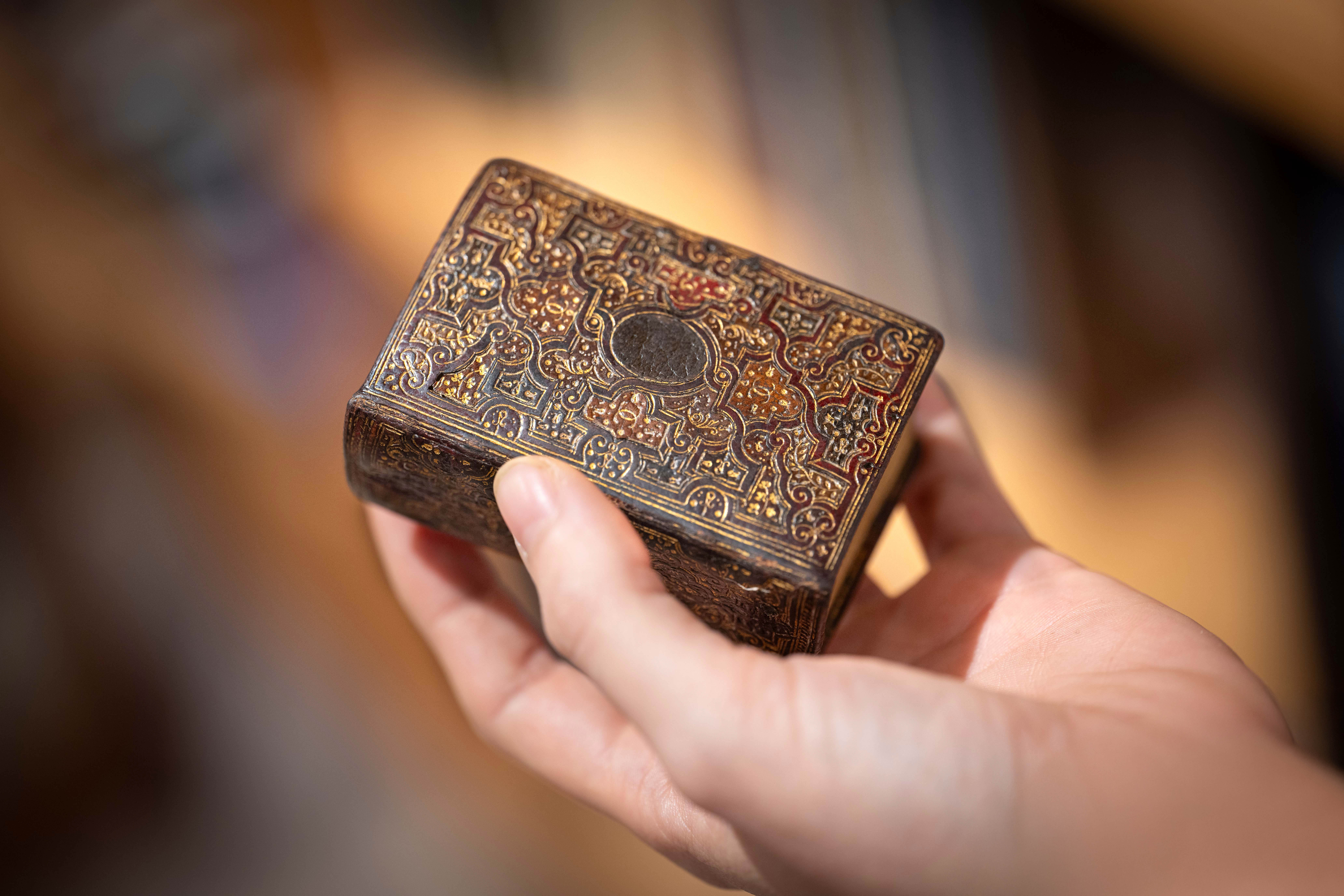
Minuscule Psalter, Paris, c. 1500, Dr. J. Günther Rare Books
Small devotional books were ideally suited to private devotion. They could easily accompany their owners on journeys and pilgrimages, be carried suspended from a girdle or belt, or even be worn on a chain like a precious pendant. Yet portability alone hardly explains why members of the French royal family commissioned manuscripts that were astonishingly small even by medieval standards. These books were luxury objects, intimate companions and artisanal masterpieces all at once.
One of the earliest royal examples we know has already appeared on this blog, in our recent post on games depicted in medieval devotional manuscripts. The famous Book of Hours of Jeanne d’Évreux, created around 1324–1328 for the Queen of France and Navarre (1310-1371), measures just 92 × 62 mm. Its remarkably small format shows that the French monarchy had appreciated luxury manuscripts of diminutive dimensions long before the remarkable flowering of tiny devotional books around 1500.
Nearly two centuries later, Anne of Brittany (1477–1514) elevated this fascination to an entirely new level. Queen first to Charles VIII and later to Louis XII, Anne assembled one of the most magnificent libraries of her age. Among her treasures was the celebrated Très Petites Heures, now preserved in the Bibliothèque nationale de France, measuring only 66 × 46 mm.
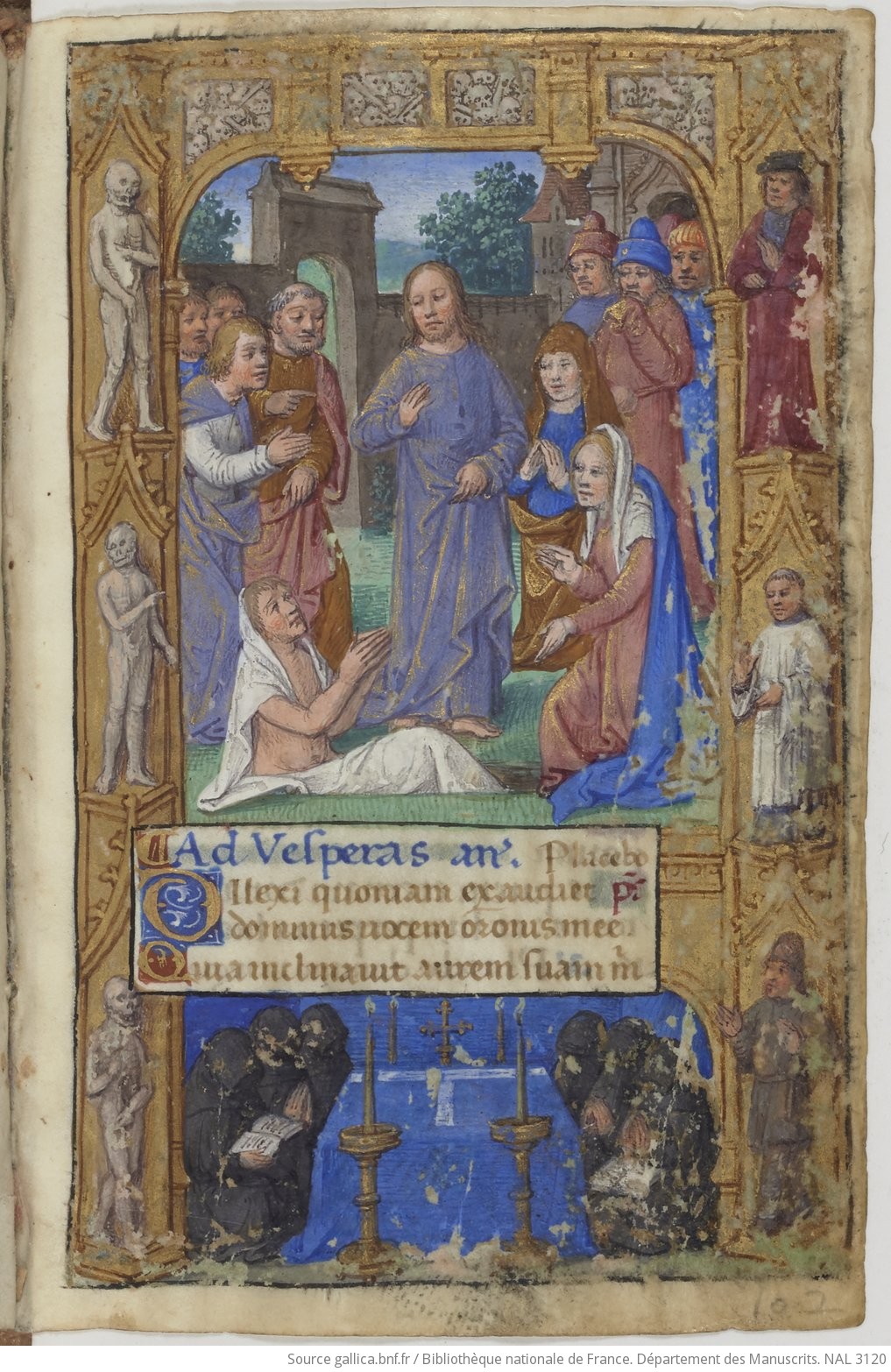
Très petites heures d’Anne de Bretagne, Paris, BnF, NAL. 3120
Anne’s daughter, Claude of France (1499–1524), clearly inherited her mother’s appreciation for exquisitely crafted miniature books. Several exceptionally small devotional manuscripts are associated with her. Her Prayer Book in the Morgan Library (M. 1166) measures only 69 × 49 mm, while a slightly larger Book of Hours, formerly in the Rothschild Collection and now privately owned, measures 84 × 55 mm.
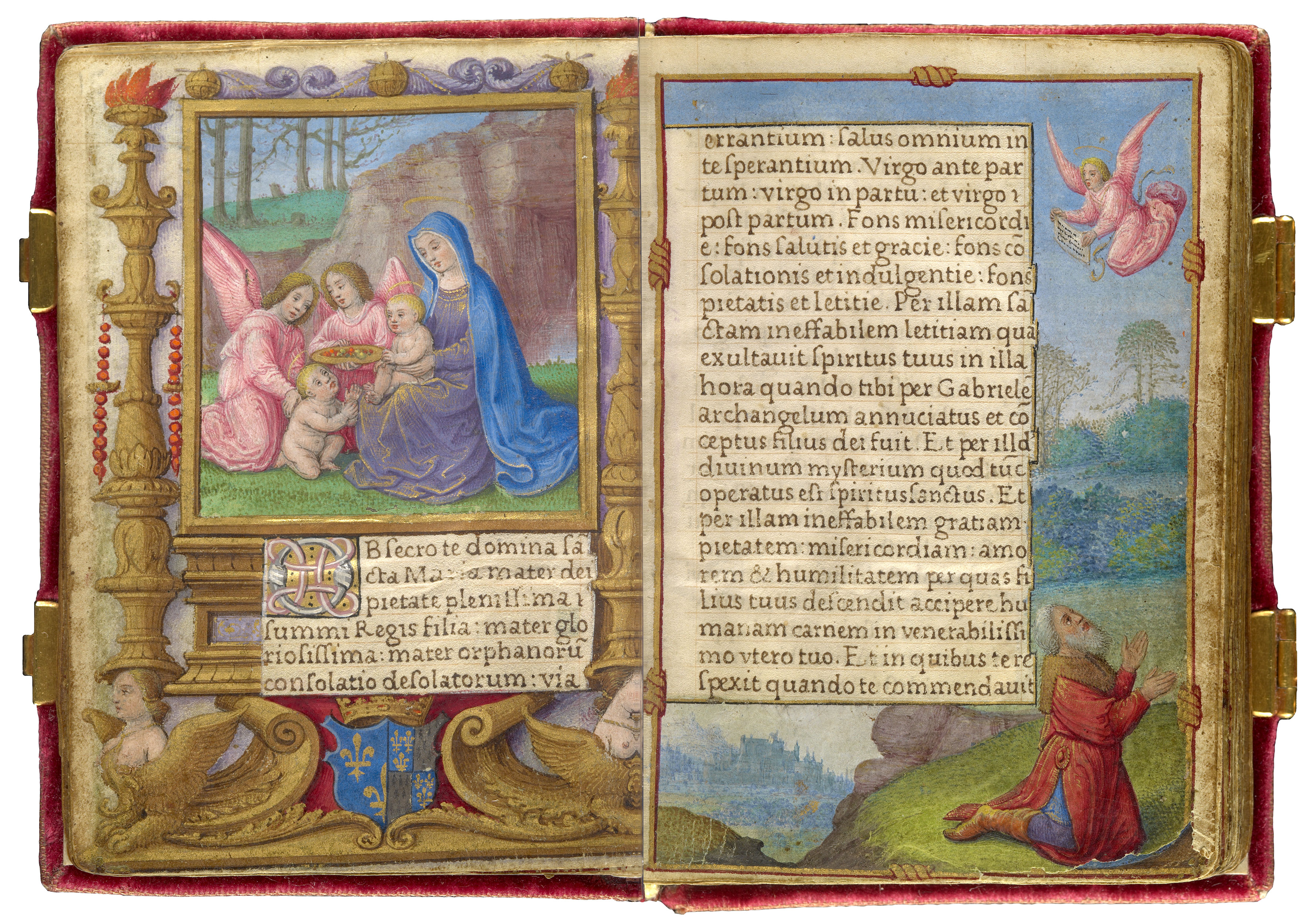
The Prayer Book of Claude de France, New York, The Morgan Library and Museum, M. 1166
Closely related is the celebrated Hachette Hours (103 × 62 mm), like the two other manuscripts illuminated by the Master of Claude de France and recently discussed by Elizabeth L’Estrange on our website. Together these manuscripts suggest that the production of tiny luxury books was not an isolated curiosity but formed part of a deliberate artistic tradition cultivated at the French court.
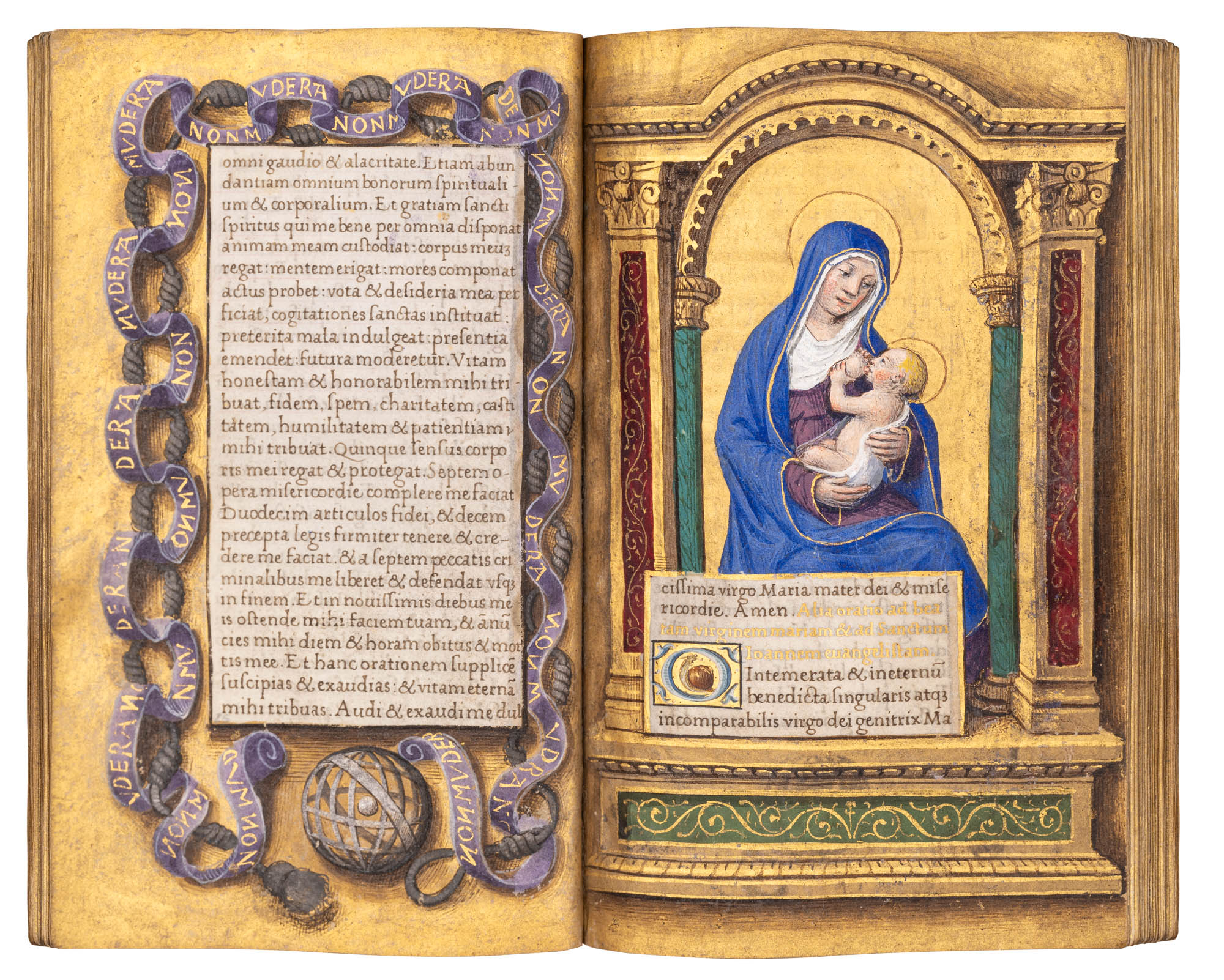
The Hachette Hours for Queen Claude de France, formerly Dr. J. Günther Rare Books, now private collection.
For many years Anne’s Très Petites Heures appeared to represent the ultimate achievement of medieval miniaturisation. Then an even smaller manuscript emerged from a noble German private collection. Known today as the Book of Hours of Mary Stuart, after one of its later owners, Mary, Queen of Scots, it measures a stunning 48 × 32 mm (see below under “Further Reading”). Although Mary probably received the book only in 1558, perhaps as a wedding gift, it had been produced some fifty years earlier for the same royal milieu as the books of Anne and Claude. Its decoration is attributed to the celebrated Parisian workshop of Jean Pichore, one of the most sought-after illuminators working for Louis XII and Cardinal Georges d’Amboise.
The tiny format of the Mary Stuart Hours naturally raise an obvious question: why were such extraordinarily small manuscripts produced in the first place? The German art historian Eberhard König has drawn attention to one particularly striking aspect of this radical miniaturisation: a single bifolium of parchment from the magnificent Grandes Heures of Jean, Duke of Berry (Paris, BnF, lat. 919), would have provided enough writing surface to produce the entire Book of Hours of Mary Stuart. Parchment was among the most expensive materials available to medieval bookmakers, yet in manuscripts of this calibre economy can hardly have been the driving force. The tiny format was itself the luxury.
König proposes an intriguing explanation for the remarkable concentration of these miniature prayer books around Anne of Brittany and her daughter Claude. He suggested that both queens may have suffered from pronounced myopia. Before the widespread use of spectacles, a very small book could actually offer an advantage to a short-sighted reader, who simply had to hold it close to the eyes in order to read comfortably. While this remains an attractive hypothesis, it is unlikely to tell the whole story.
Another factor may have been the growing fascination with artistic virtuosity and extraordinary objects. Around 1500, collectors and patrons increasingly valued works that astonished through their technical perfection and their ability to transcend ordinary expectations. The tiny manuscripts produced for the French court seem to anticipate the taste that would fully blossom in the Kunst- und Wunderkammern of the 16th and 17th centuries, where miniature masterpieces, precious curiosities and objects of exceptional craftsmanship were prized precisely because they inspired wonder.
A tiny Psalter from the Workshop of Jean Pichore
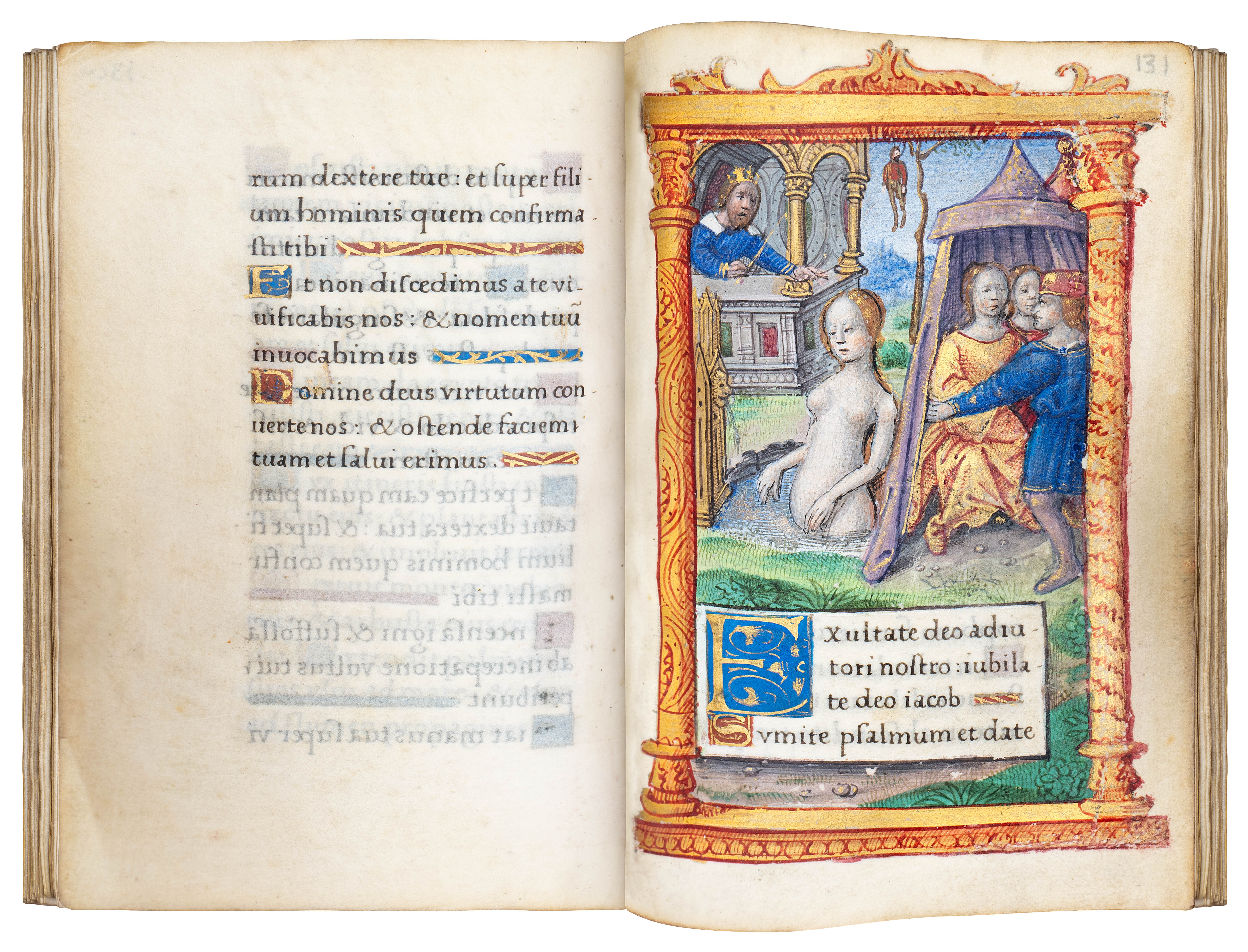
Remarkably, another manuscript from this same artistic circle survives: a tiny Psalter measuring 68 × 43 mm, illuminated with fifteen lively miniatures. Together with the Mary Stuart Hours it demonstrates that these miniature masterpieces were not isolated commissions for Pichore’s workshop but belonged to a broader group of luxury manuscripts produced in Paris around 1500.
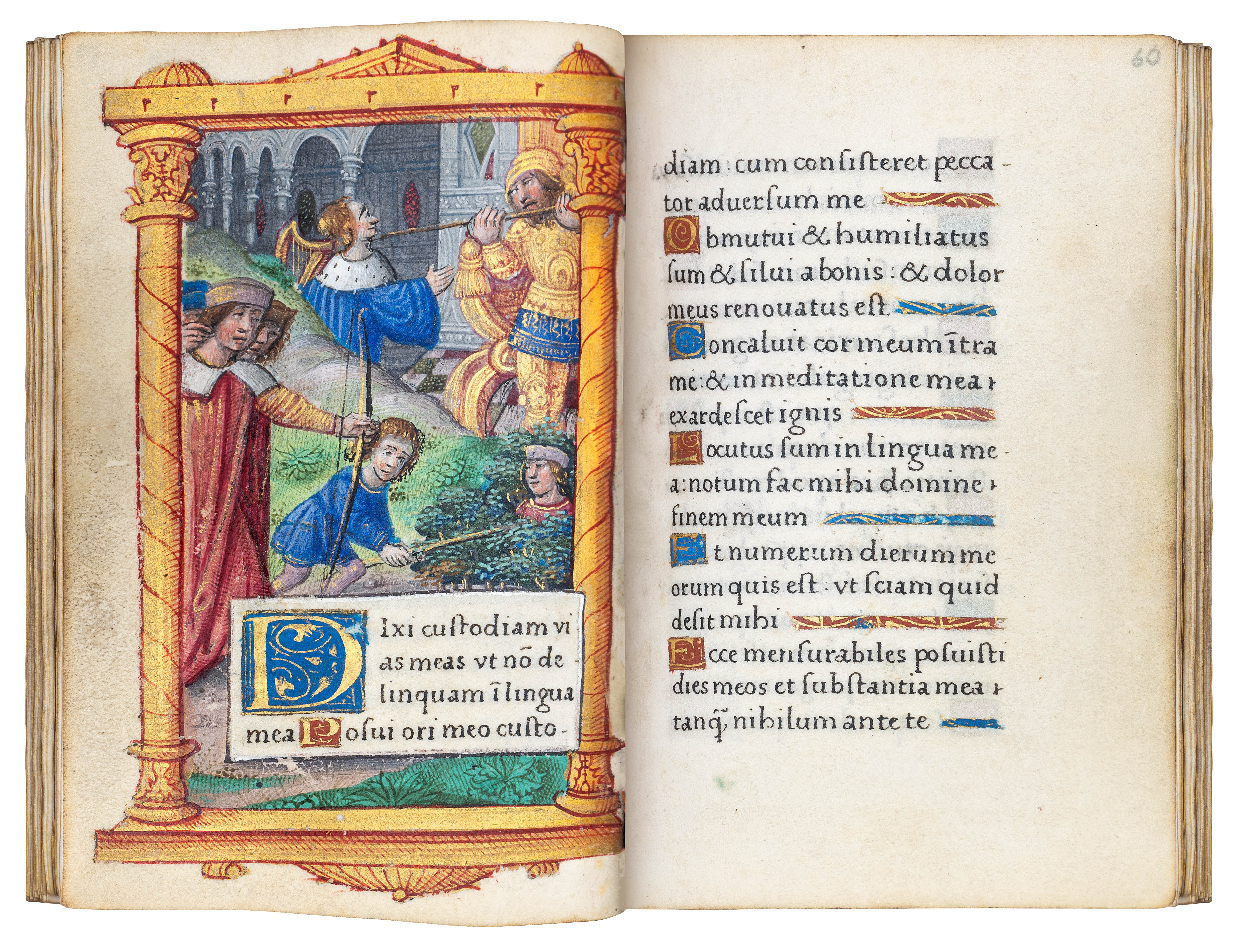
Minuscule Psalter, Paris, c. 1500, illuminated by Jean Pichore and his workshop, Dr. Jörn Günther Rare Books
The two miniatures perfectly illustrate the rich narrative programme of our tiny Psalter. One shows one of the most familiar episodes from the life of King David—his first glimpse of the beautiful Bathsheba bathing before he summons and seduces her. The other depicts a far less common subject: Jonathan, Saul’s son, carrying his bow and arrows, while in the background David plays the harp before the tormented King Saul, who suddenly attempts to kill him with a spear.
Even more examples have surfaced in recent years. Harvard University now preserves two further devotional manuscripts from Pichore’s workshop, measuring 70 × 45 mm and 55 × 40 mm, respectively, both from the collection of Julian Edison.
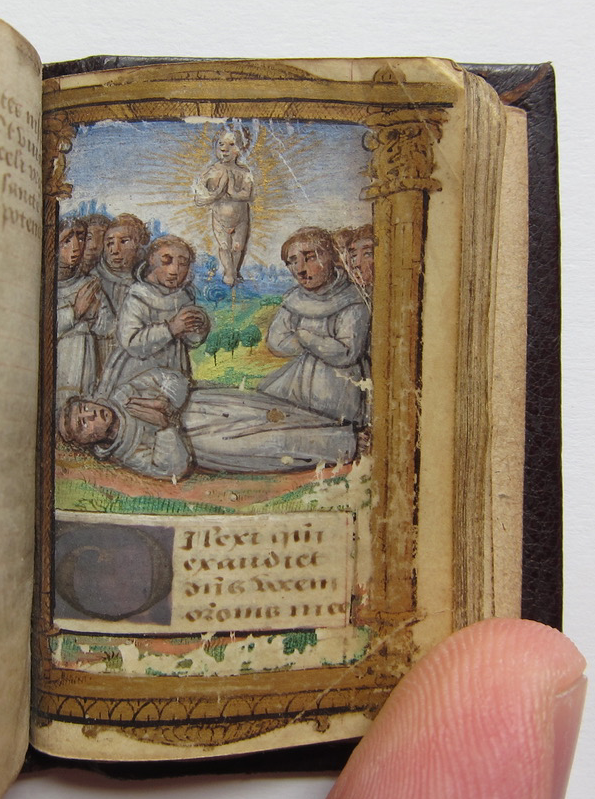
Hours of St. Francis, Houghton Library, Harvard University, 2020HEM-70
What inspired this extraordinary taste for miniaturisation? Scholars have proposed several explanations. Their diminutive size certainly made the books convenient companions for private devotion, but practicality alone cannot account for such extreme reduction. Rather, these manuscripts seem to celebrate the astonishing precision that highly skilled scribes and illuminators could achieve. Every letter, every border and every miniature had to be executed on a scale that demanded exceptional eyesight, steady hands and extraordinary concentration.
König has argued that the true marvel of these books lies not primarily in their paintings but in the microscopic script itself. By around 1500, Parisian scribes had mastered a refined humanistic script that allowed entire liturgical texts to be compressed into pages scarcely larger than a modern business card, while still remaining legible. The tiny Books of Hours therefore represent not merely luxurious objects of devotion but the culmination of centuries of manuscript craftsmanship.
In her commentary on the Book of Hours of Mary Stuart, Myra D. Orth suggests that the scribe of that manuscript was probably also responsible for Claude de France’s Prayer Book in the Morgan Library. She further proposes that this exceptionally accomplished scribe belonged to the circle of the publisher, calligrapher, and type designer Geoffroy Tory (c. 1480–1533), royal printer to king Francis I. An observation by the paleographer Marc H. Smith (École des Chartes) now lends further support to this hypothesis: our miniature Psalter and the Hachette Book of Hours were almost certainly copied by the same hand. It is therefore tempting to suggest that many—perhaps even most—of these tiny yet perfectly legible devotional manuscripts produced for the French royal court originated within the circle of Geoffroy Tory’s scribal workshop.
One final, admittedly speculative thought may be worth considering. The remarkable concentration of these tiny manuscripts around the workshop of Jean Pichore raises the possibility that they were conceived not merely as objects of private devotion, but also as particularly fancy gifts. Their jewel-like appearance and portable format would have made them ideal presents to bestow upon favoured princes, princesses, and other members of the European high nobility. If so, the handful of surviving examples may represent only a small remnant of what was once a much larger group of such precious diplomatic gifts.
Therefore, we would be especially grateful for any references to further examples or relevant publications. Comments, suggestions, and constructive criticism are always most welcome.
*Please note: Confusingly, the word “miniature” that we also use for the paintings in manuscripts has nothing to do with small size. It derives from the Latin minium, the red pigment used for rubrication and early manuscript decoration. From this developed the Italian miniare (“to illuminate”), and eventually miniature became the standard term for painted decoration in manuscripts—whether the manuscript itself was large or small.
Further reading
- There are no images of Mary Stuart’s Book of Hours available online. For a good impression of the book’s tiny size, see the facsimile: Das Stundenbuch der Maria Stuart. Handschrift aus dem Besitz des hezoglichen Hauses Württemberg. 2 vols. facsimile and commentary, With contributions by H. Decker-Hauff, E. König, M. D. Orth, and J. Rathofer, Darmstadt 1988.
- Bondy, Louis W. Miniaturbücher. Von den Anfängen bis heute, München 1988.
- On the illuminators mentioned here: Avril, François, and Nicole Reynaud, eds. Les manuscrits à peintures en France, 1440-1520, Paris 1993.
- On Jean Pichore: Zöhl, Caroline. Jean Pichore: Buchmaler, Graphiker und Verleger in Paris um 1500, Turnhout 2004.
- Bromer, Anne C. and Julian I. Edison. Miniature Books – 4000 Years of Tiny Treasures, New York 2007.
- Wieck, Roger. Das Gebetbuch der Claude de France : MS M.1166, The Pierpont Morgan Library, New York. Lucerne/New York 2010.
- Deprouw, Stéphanie (ed.). Geoffroy Tory: Imprimeur de François Ier, Graphiste Avant La Lettre. Paris 2011.
- König, Eberhard. Das Stundenbuch der Claude de France Konigin von Frankreich . Illuminationen 18, Ramsen 2012.
- Wieck, Roger S. Miracles in Miniature: The Art of the Master of Claude de France, New York, 2014.
- Castaño, Mireia. ‘The Hachette Hours’. In: Mirabilia. A Legacy Brought to Light. Dr. J. Günther Rare Books, Brochure 21, no. 35, Basel 2025.