





Treasures from Longleat House Library

In this blogpost, Dr. Timothy Bolton invites you to the glorious library of Longleat House, seat of the Marquesses of Bath, and presents a selection of manuscripts, which were a part of Longleats legendary collection.
There is something magical about books that come directly from an old noble library. Unlike others, that have long provenances with lists of private owners and a handful of appearances at auction or in sale catalogues, they often entered the library some centuries ago, perhaps even immediately after the English Reformation or the Secularisation in Europe. They may have passed directly from monasteries and Cathedral schools to that noble library, or through a few intermediaries, entering a form of slumber, forgotten and sleeping away the centuries. This is even more pronounced with books from Longleat House as it has remained first and foremost a private collection, with fewer books leant for exhibitions and fewer scholars passing through its shelves than in other great English houses.

A glorious view of Longleat House, Wikicommons.
The origins of Longleat’s library are inseparable from the history of the house itself. The estate occupies the site of a priory of Augustinian canons, active for roughly 250 years before its suppression in 1529. A decade later the property passed to Sir John Thynne; the first major initiator of the collection was his uncle, William Thynne, a senior official in Henry VIII’s household and the editor of the great 1532 edition of Chaucer. Between 1568 and 1580 Sir John commissioned the building of the great Elizabethan house that stands today; he had risen at court thanks to his position as steward to the Duke of Somerset, the Lord Protector during the minority of Edward VI. Longleat has remained in the family ever since, and in 1949 became one of the first great stately homes in Britain to open its doors to the public — yet the library has always remained, above all, a private treasure.
It should be noted that, apart from their recent transfer of ownership, no book discussed here appears to have been sold since considerably before the birth of Napoleon or the American signing of the Declaration of Independence. Thus, opening a book from Longleat puts you among a tiny number of people who have seen its pages since the close of the Middle Ages, and with each page turned there is the thrill of a potential new discovery, something no one else alive has yet noticed.

Library of Longleat House, Wikicommons.
The glorious ‘Longleat Pupilla Oculi’ was illuminated in the first half of the 15th century by the same artist who painted the ‘Corpus Trolius and Creseyde’ (Cambridge, Corpus Christi College, MS. 61), and who may originally have been in the entourage of Charles d’Orléans before coming to work in England. The present codex has rightfully been called the ‘showcase’ manuscript for the text – a pastoral manual meant to guide the clergy through the church’s penitential and sacramental laws – and it is, perhaps, among the grandest English books to ever appear again on the international market.
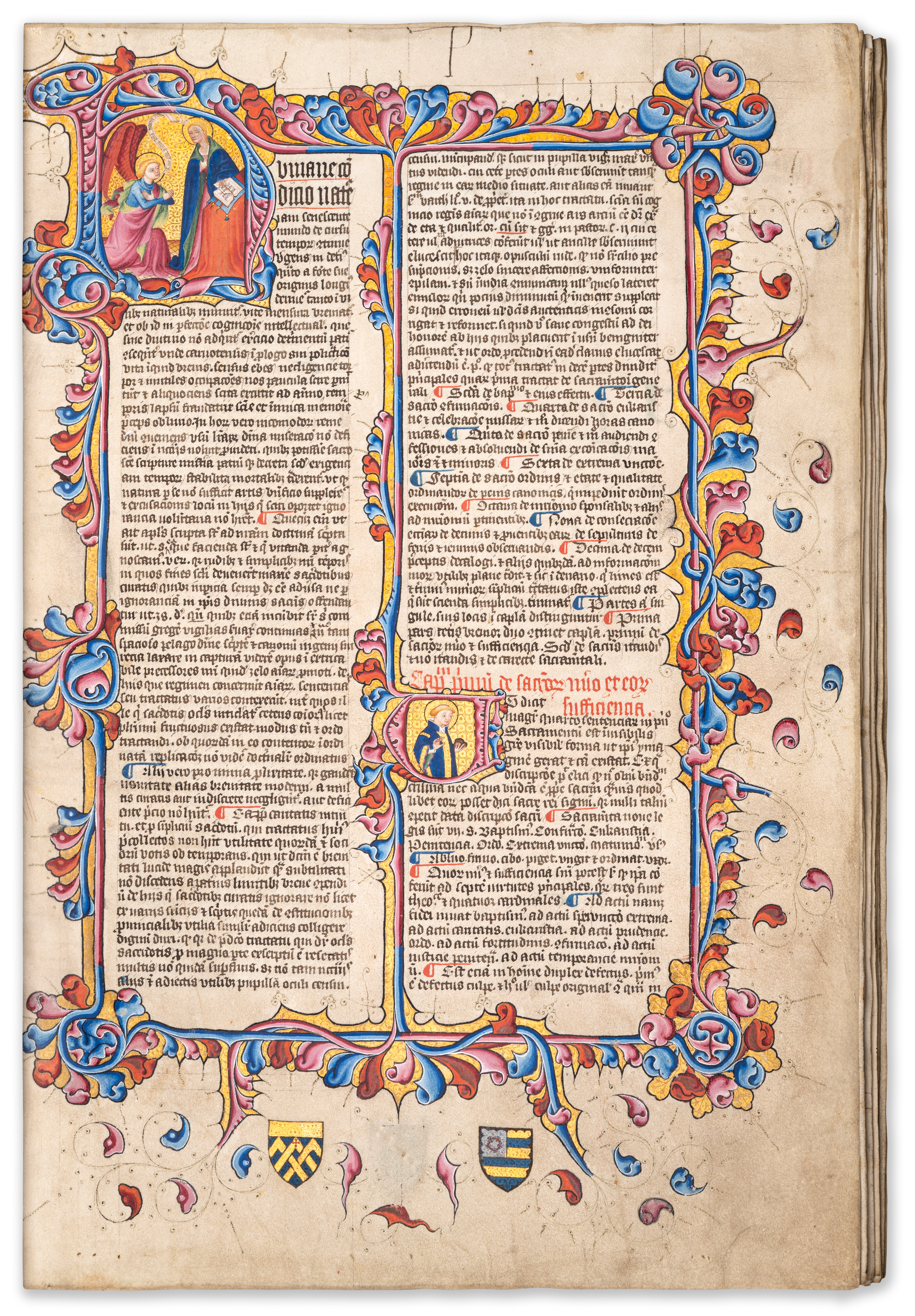
John De Burgh, Pupilla Oculi , with other collections of canons of English Church councils. Manuscript in Latin on vellum. England, London (?), c. 1415 – 1420, 450 x 310 mm.
From the other end of the Middle Ages, from the decades after the Norman Conquest and the social revolution that followed it, we have two equally important monastic books: the ‘St Benet Holme Apocalypse’ and the ‘St Augustine’s Scientific Compendium’. The first contains a commentary on the Apocalypse by Berengarus that appears to have been common in Normandy. However, this copy with its finely executed full-page illustration and a historiated initial formed of a man fighting a fantastic beast, was most probably produced in England in the late 11th or early 12th century, representing the new Continental learning that came in the wake of the Norman invaders. In addition, it is the earliest known manuscript from the medieval library of the Abbey of St Benedict, in St Benet Holme.
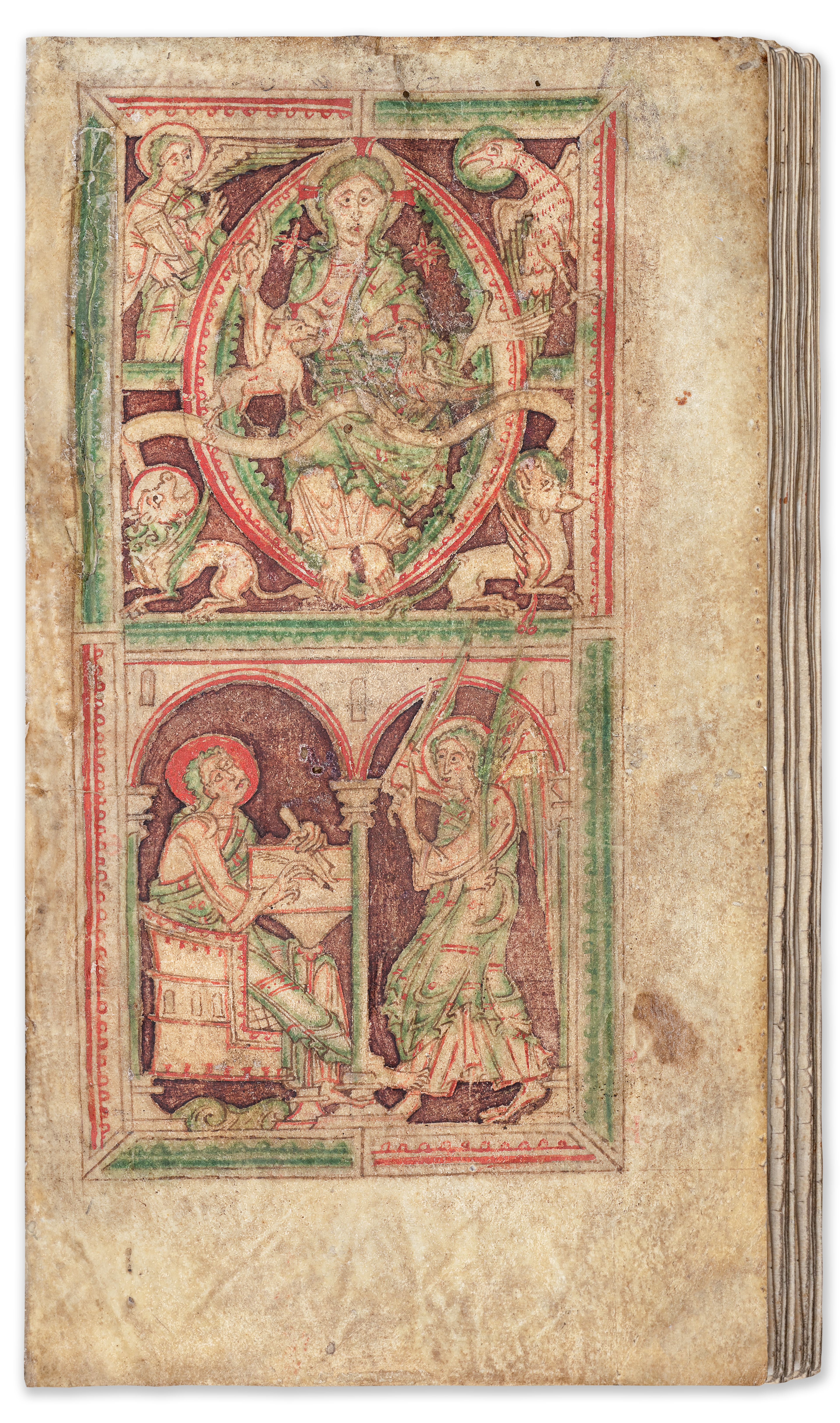
The St-Benet Holme Apocalypse. Berengarus, Expositio super septem visiones libri apocalypsi. Manuscript in Latin on vellum. England, probably Norfolk, late 11th or early 12th century, 210 x 115 mm.
The second of these two Anglo-Norman books takes us from theology to medieval science and was produced in England in the late 12th-early 13th century for the library of St. Augustine’s, Canterbury. It contains a large collection of early scientific and astronomical texts, several with detailed illustrations, and many coming to England from Normandy, and one – that of Adelard of Bath on the use of astrolabe (a form of medieval computer) – the earliest English composition on the subject. Its pages are a testament to the curiosity and achievements of medieval people, and one can find here treatises on the composition of the universe and the planets, the climates of the earth and the calculation of Easter, a detailed description of the heavens and celestial bodies with instructions how to measure the movement of these, and the workings of practical scientific equipment.

f. 54r Large diagram showing the courses of the seven planets through the zodiac. Detail from The Canterbury Saint-Augustine Compendium. Manuscript in Latin on vellum. England, probably Canterbury, late 12th or early 13th century, before 1230, 195 x 135 mm.
Last, but certainly not least, a few words must be said about the ‘Medici-Longleat Josephus’, a glittering copy of the works of Josephus in Latin translation, produced c. 1450 in Florence, thus at the height of Italian Renaissance and at its cultural epicentre, most probably as a commission for Cosimo de’ Medici, founder of his banking dynasty and duke of Florence. It has a frontispiece showing the author holding a book as well as 30 very large white-vine illuminated initials, and perhaps most importantly, is still in its armorial binding, made for Cosimo’s son, Piero. As an early Medici binding this is of breathtaking rarity, and is probably one of only four such bindings surviving today.
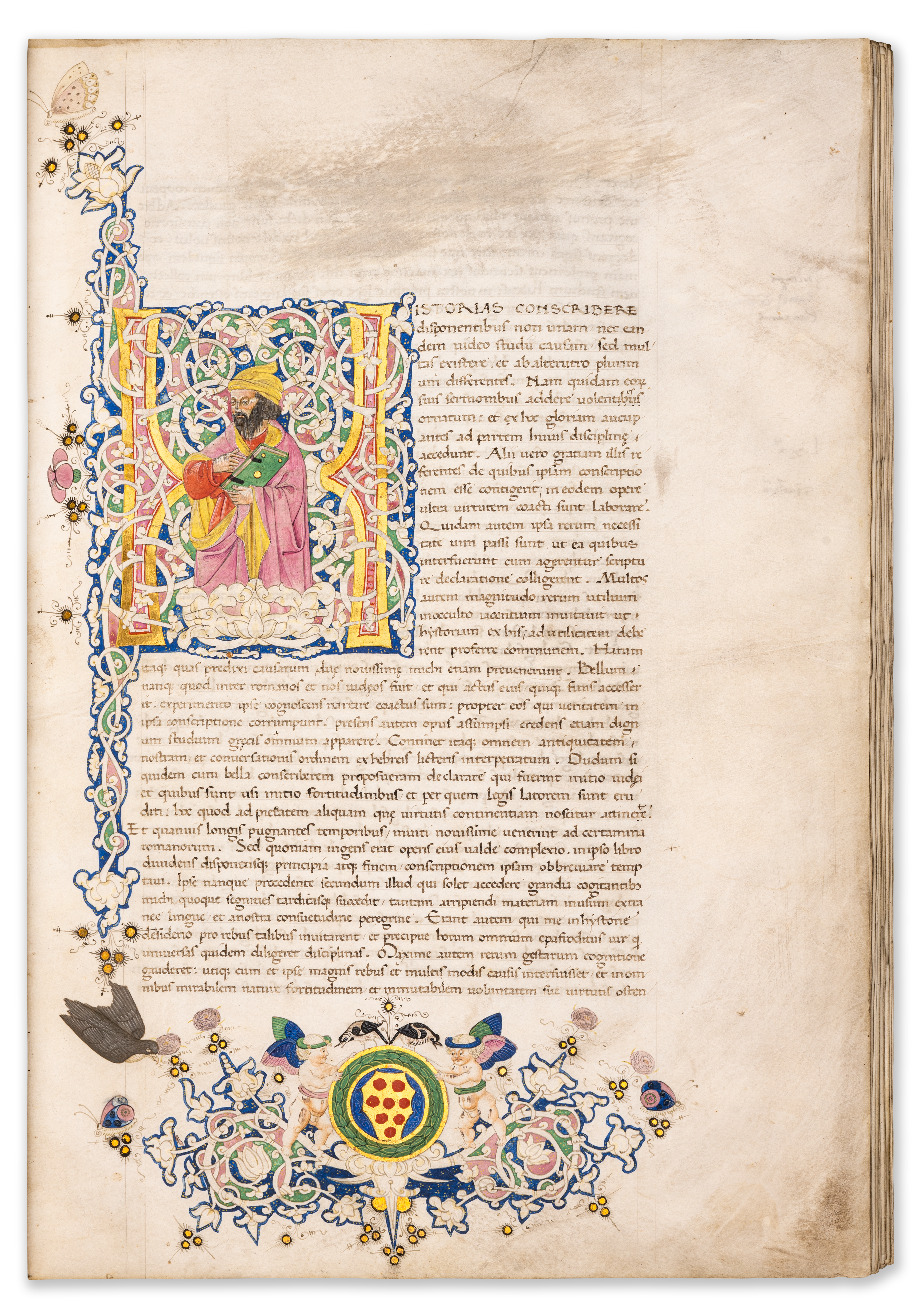
f. 1r: Large historiated initial ‘H’ with scrolling white vine, inhabited by a portrait of the author holding a book; bas-de-page with putti and birds flanking the Medici arms. Frontispiece from Flavius Josephus, Antiquitates Iudaicae; Contra Apionem I – II; De bello iudaico . Manuscript in Latin on vellum. Italy, Florence, c. 1450, 392 x 275 mm.