





The Croÿ-Arenberg Hours
Use of Sarum (Salisbury)
- Master of Sir George Talbot and a collaborator
- Master of the Older Prayerbook of Emperor Maximilian
- Master of the David Scenes in the Grimani Breviary
- Artist from the circle of the Master of James IV of Scotland
Manuscript in Latin on vellum
Flanders, Ghent or Bruges, c. 1508-20.
211 x 153/156 mm
Price on request.
206 (of 209?) leaves. 15 full-page miniatures pasted in, 29 smaller miniatures and 17 historiated initials, 24 his-toriated borders for the Calendar and 13 for the text, 56 decorative full borders. All other pages decorated with two single motifs in the outer and the lower margin. Later binding of velvet and silk over wooden boards.
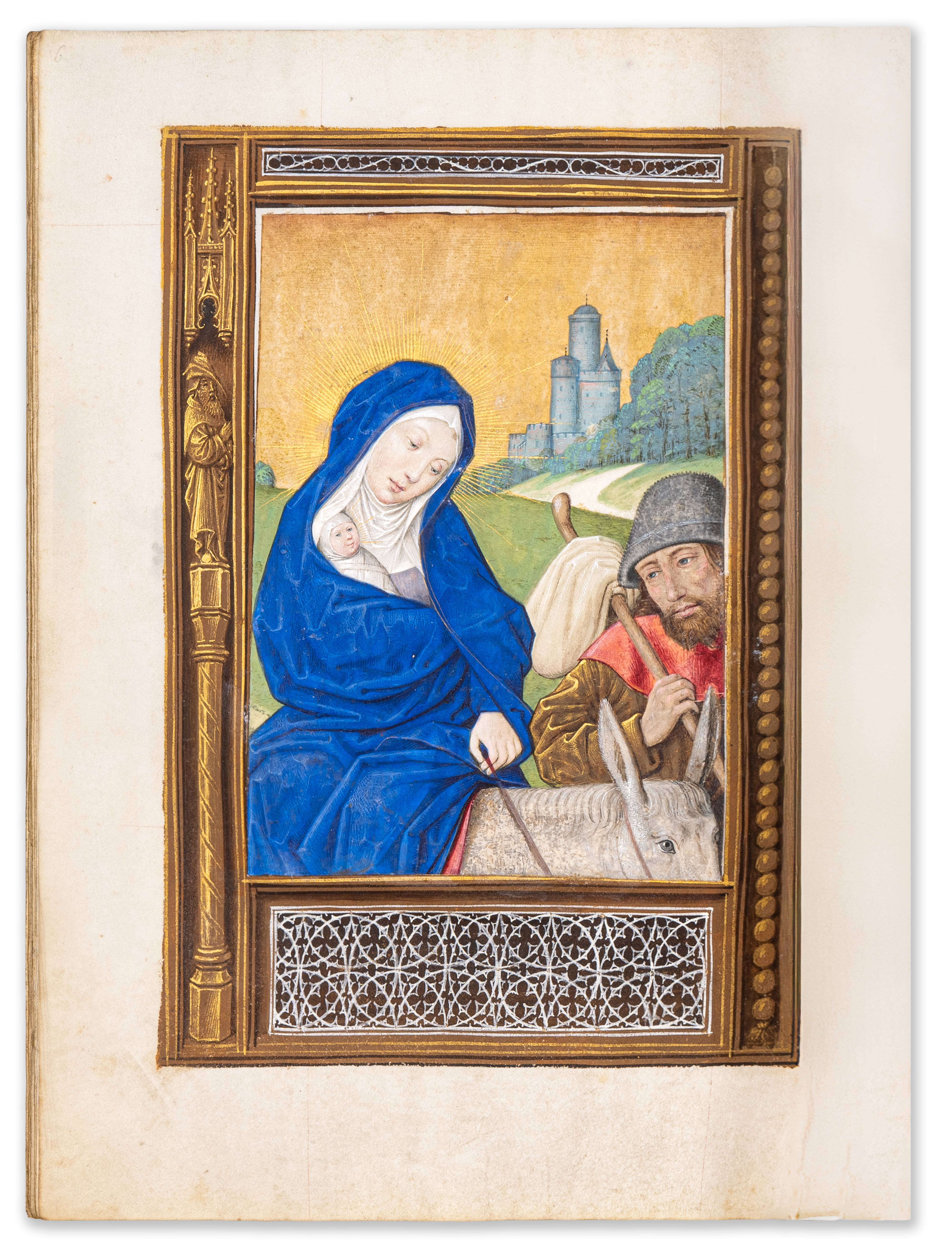
This Book of Hours is, according to Smeyers, “one of the key achievements of Flemish miniature arts.” It is a luxurious production of the finest quality, probably made for a high-ranking member of the English royal court, as strongly suggested by the Tudor roses in the marginal decoration (perhaps Arthur Plantagenet).
Flemish Books of Hours from the early 16th century are often breathtaking in their richness, complexity and beauty. This manuscript, however, is among the most gorgeous of its kind. Its uniqueness is in no way compromised by a certain degree of standardisation in its production. At the centre of our picture cycle are compositions, based on models by one of the most important Flemish illuminators Simon Marmion (c. 1425-1489), highly esteemed and known to his contemporaries as the prince of illumination (prince de l’enluminure). The reproduction of older models was intended as a genuflection before the honoured predecessor. Our manuscript combines the utmost splendour with an uncommon text and image program: an exclusive artwork for a discerning and educated customer.
The Tudor dynasty was founded by Henry VII (1457/reigned 1485-1509) and continued by his son Henry VIII (1491/reigned 1509-1547). Our Book of Hours must have been created after 1508, as the Madonna on the Crescent Moon on f. 94v is a close copy of an engraving by Albrecht Dürer dated 1508. The manuscript gives us one more clue as to the identity of its commissioner: The letters “A” that are painted as pendants attached to the margins of ff. 36r and 188r. A member of the royal family, whose life dates would fit the production time of the manuscript is Arthur Plantagenet (before 1472-1542), Viscount of Lisle. He was a close confidant and faithful companion of Henry, English heir to the throne and later King Henry VIII.
The commission for the Croÿ-Arenberg Book of Hours was undoubtedly motivated by an as yet unknown patron’s desire for uniqueness. Various allusions in the design allow cautious conclusions to be drawn about a highly cultured, educated and, of course, wealthy client. The last great mysteries of this fantastic Book of Hours have not yet been solved. There is so much to discover and interpret that this devotional book would actually be worthy of its own research project.


